Hiring Map May 2026: 5 Surprises in 30,000+ India Jobs
After tracking more than 30,000 jobs from MNC career pages, the data tells a different story. Pune outranks Hyderabad. Two pharma companies post 1,000 roles. 'Collaboration' is listed 229 times and required 3. Free skill-gap analysis inside.
Is Pune a bigger tech-hiring city than Hyderabad in 2026?
In this data, yes. Pune had 768 active jobs against Hyderabad's 396 in the April 2026 window — though Pune's volume comes from just five large captives such as CMA CGM and Alstom. Treat it as one batch's snapshot, not a weekly trend.
Do employers actually require soft skills like collaboration?
Mostly no. 'Cross-Functional Collaboration' appears 229 times in skill tags but only 3 postings list it as a primary requirement; 'Quality Culture' appears 179 times with zero primary. The real primary requirements are engineering practices — programming languages, development methodologies and requirements engineering.
Who hires more in India — Big Tech or the consultancies?
The consultancies. Accenture alone posted 1,000 roles on 19 April; Accenture, Cognizant and DXC together total 1,594 — larger than every Big Tech name in the dataset combined (around 450).
What skills should I put on my CV for India tech jobs in 2026?
Prioritise the actual primary requirements: one programming language with a production project (Python, Java, Scala or Go), one development methodology you can defend in interview (Agile, TDD, BDD), and one or two data or cloud infrastructure skills. That covers roughly 20–25% of the dataset.
Myro reads your CV and scores it across 10 career domains against live hiring demand — the same data behind this issue. You get your Myro Score, the roles you can land now, and the exact skills to close the gap. See how it works →
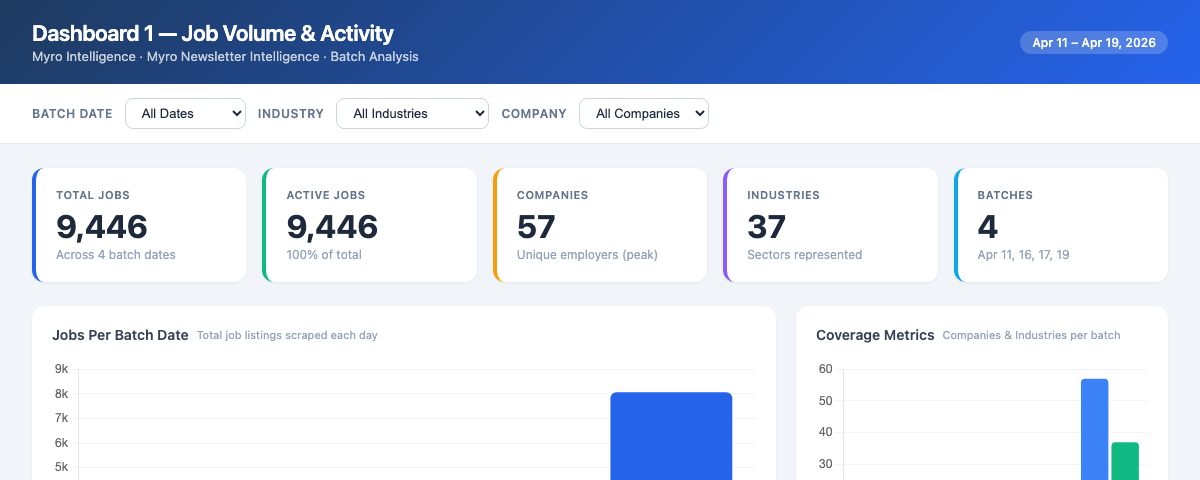
After tracking more than 30,000 jobs from MNC career pages and analysing a 9-day April window of 9,446 active listings across 60 enterprise employers, the data answers five questions Issue 001 did not. Pune sits second on the city leaderboard. Two pharmaceutical companies posted a thousand roles between them in one Saturday batch. The single most-listed skill across all postings is "Cross-Functional Collaboration," and across 229 mentions, exactly three job ads list it as required.
TL;DR
India accounts for roughly 4,200 of the 9,446 jobs in our analysed slice. The "global enterprise tech hiring" story is mostly an India-economy story dressed in American logos.
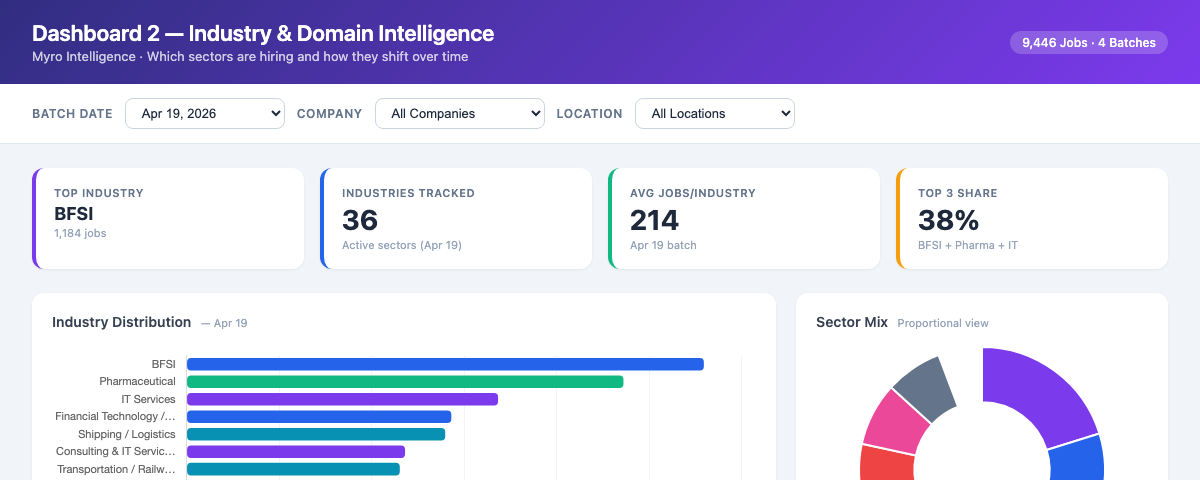
Top 5 industries hold 51% of jobs: BFSI (1,184) + Pharma (1,000) + IT Services (713) + FinTech (606) + Logistics (592) = 4,095 of one Saturday's 8,059 listings.
Soft skills are window dressing. "Cross-Functional Collaboration" appears 229 times in skill tags; only 3 postings list it as primary. "Quality Culture" appears 179 times; primary appearances: zero.
Accenture alone posted 1,000 roles on a single day. The Indian outsourcing trio (Accenture, Cognizant, DXC) totals 1,594 jobs, larger than every Big Tech name in our dataset put together.
Job Volume & Activity — April 2026
Surprise #1: Pune is now the second-biggest tech city we track
Hyderabad has been the canonical "second" Indian tech city in popular narrative for half a decade. Our data puts Pune ahead of it by a clean margin.
City (de-duplicated)
Active Jobs
Companies
Bangalore (all variants)
996
20
Pune
768
5
Bengaluru (variants)
404
12
Hyderabad
396
8
Noida
250
4
Chennai
226
8
Mumbai
61
9
Gurgaon
32
1
Pune's 768 jobs come from just five companies, which means the city's hiring is concentrated in a small number of large captives. CMA CGM (the French shipping major) and Alstom (French rail) run their global tech hubs out of Pune; both showed up in the data with hundreds of open roles.
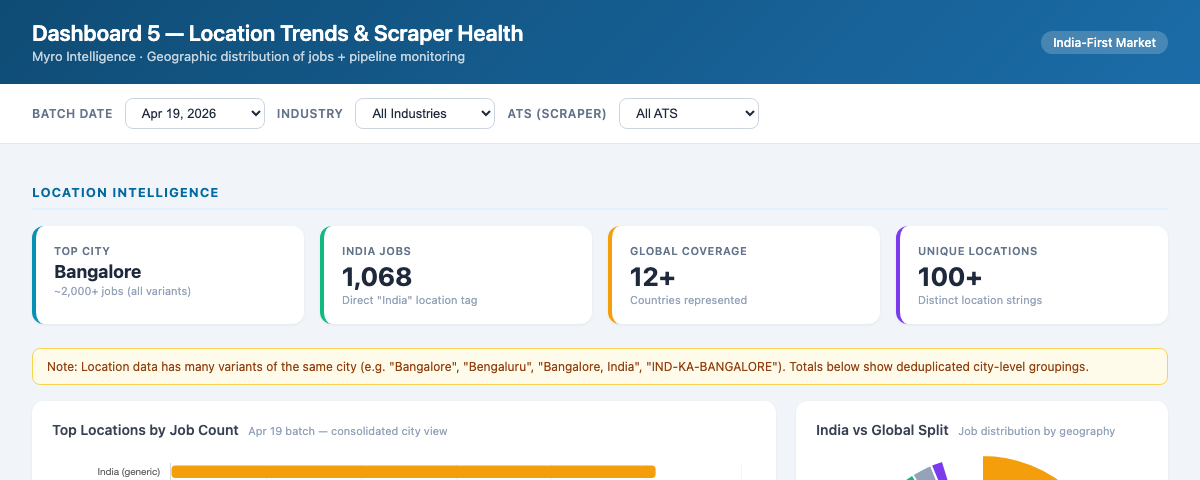
The other striking number: 1,068 jobs tagged with just "India" and no city. Most of those are real Indian-city roles whose location field was filled by the company at country-level. The true India total in our analysed slice is well above 4,200.
Here, we would like to discuss data hygiene in corporate ATS systems. The location field is one of the dirtiest columns in any jobs database, which is partly why most consumer job boards underweight Indian roles in their search rankings. Their de-duplication is doing your search a disservice.
For someone planning a relocation in 2026, the data says Bengaluru is saturated and competitive. Hyderabad has not pulled ahead the way the narrative claimed. Pune is undervalued and growing in pure volume.
Location & Geography Breakdown
Surprise #2: Pharma is hiring at scale, with two companies
Pharmaceutical jobs make up 1,000 of one batch's 8,059 active postings, roughly 12.4%. The shape of that number matters.
Industry
Jobs (Apr 19)
Companies
BFSI
1,184
6
Pharmaceutical
1,000
2
IT Services
713
3
FinTech / Payments
606
2
Shipping / Logistics
592
1
Consulting & IT
500
1
Transportation / Railway
488
1
Technology / SaaS
439
1
IT Services & Consulting
383
1
Fintech
299
4
BFSI hits its 1,184 by spreading across six companies. Pharma reaches 1,000 with two: Sanofi (500) and Novartis (500). Add Eli Lilly (46) and AstraZeneca (15) and you are looking at four pharma companies driving an industry's worth of hiring while the category gets almost no airtime in 2026 career coverage.
Concentration is a signal. When two employers carry an industry, your job search has a much smaller surface area to optimise. You learn what Sanofi and Novartis want, you tailor for both, you have covered most of pharma's 2026 demand. By contrast, BFSI's 1,184 jobs are split six ways: Barclays, State Street, DBS, Wells Fargo, Fidelity, JPMorgan and others each demand different skill stacks.
Diffuse demand rewards generalists. Concentrated demand rewards specialists. Pharma in 2026 is a specialist play.
Industry & Domain Breakdown
Surprise #3: The skills companies list, and the skills they require, are different lists
This is the finding we expect most readers to argue with. Here is what the data shows.
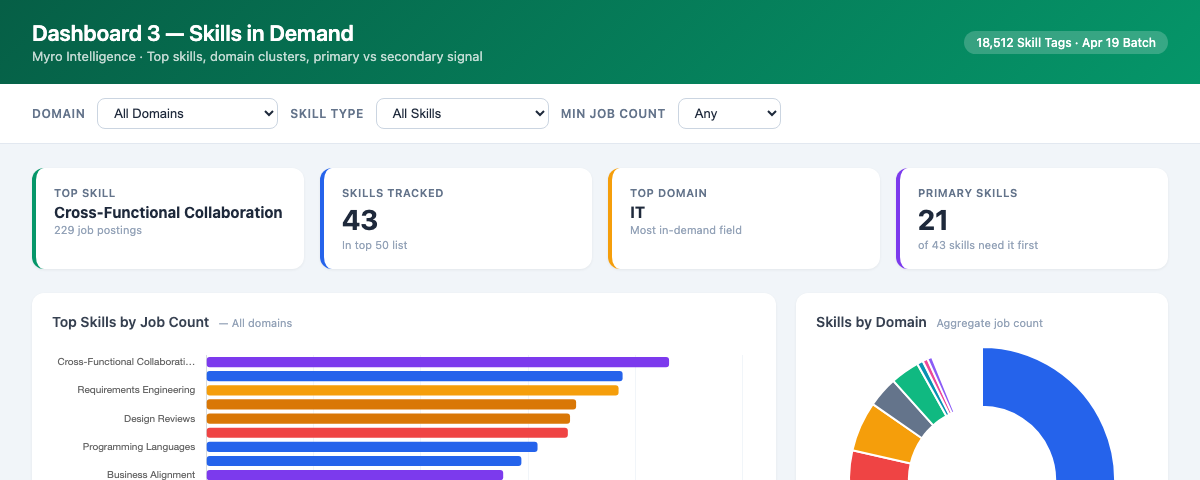
We tagged 18,512 individual skill mentions across the 9,446 postings in our analysed window. Each tag is either primary (a critical, must-have requirement) or secondary (a nice-to-have or general capability). When you sort by total mentions, the top of the list looks like this.
Skill
Total mentions
Primary
Secondary
Cross-Functional Collaboration
229
3
226
Software Development Methodologies
206
189
17
Requirements Engineering
204
176
28
Product Requirements
183
6
177
Design Reviews
180
5
175
Quality Culture
179
0
179
Programming Languages
164
164
0
Cross-Functional Integration
156
0
156
Business Alignment
147
0
147
Solution Design
144
141
3
Look at the primary column. Cross-Functional Collaboration: 3. Quality Culture: 0. Cross-Functional Integration: 0. Business Alignment: 0.
What is primary at scale tells a different story. Programming Languages (164 of 164). Software Development Methodologies (189 of 206). Requirements Engineering (176 of 204). Solution Design (141 of 144). Add Data Pipelines (30 primary), Machine Learning (30 primary), Cloud Technologies (25 primary), Functional Testing (25 primary), Data Warehouse Architectures (25 primary).
The primary requirements are unsexy engineering practices. The secondary mentions are organisational and behavioural language that companies use to describe culture. A reader optimising their CV for the headline skills is optimising for the language of postings, not the language of requirements.
This is exactly why primary skills must be read separately from secondary ones. The gap between what a company says it values and what it requires you to have is where most candidates lose six weeks of wasted retraining.
If you are updating a CV this week, prioritise: a programming language stack (any one of Python, Java, Scala, Go), one development methodology you can defend in interview (Agile, TDD, BDD), one delivery framework, and one or two data infrastructure skills. That covers the actual primary requirements across roughly 20 to 25% of the dataset.
Skills Demand & Primary vs Secondary Split
Surprise #4: Accenture is bigger than Big Tech here
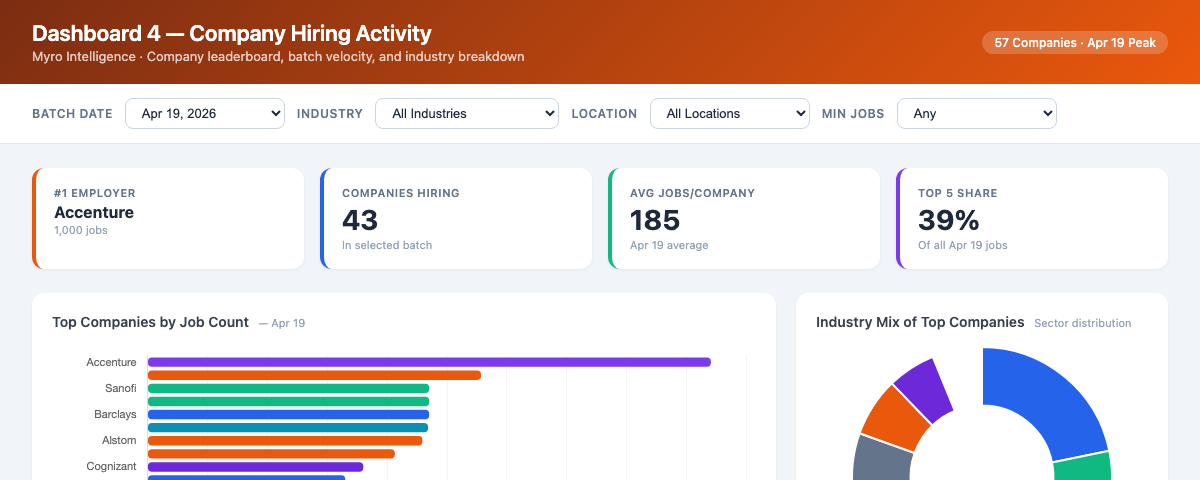
A single company posted 1,000 jobs on April 19. That is Accenture. Two days earlier they posted another 427. Cognizant added 383. DXC added 211. Together that is 1,594 jobs from three Indian outsourcing and consulting majors.
For comparison, in the same dataset:
Company
Active jobs
Type
Accenture (Apr 19)
1,000
IT Services
CMA CGM
592
Shipping
Sanofi
500
Pharma
Novartis
500
Pharma
Barclays
500
BFSI
Stripe
498
FinTech
Alstom
488
Railway
ServiceNow
439
SaaS
Cognizant
383
IT Consulting
State Street
351
BFSI
Adobe (207), Mastercard (108), Intel (68), Salesforce (30), Amazon (9), Airbnb (15), Microsoft (not in this batch). The marquee Big Tech roster, summed, is around 450 active jobs across the visible companies. Accenture by itself doubles that.
This matters for two reasons. First, the entry door for early-career talent in 2026 is mathematically through the consultancies. The volume is there, the hiring bar is broad, and the skill stack required is exactly the unsexy primary set from Surprise #3. Second, the public discourse keeps treating "tech jobs" as synonymous with FAANG, and the data simply does not back that up at this point in India's enterprise cycle.
There is also a quieter surprise inside the top 10: CMA CGM (French shipping), Alstom (French rail), and Sanofi/Novartis (French pharma) sit at #2, #7, and #3-4. Three of the top eight roles in our dataset come from companies headquartered in France, hiring in India. If you wanted to find an under-covered hiring corridor in 2026, that is it.
Company Hiring Activity
Surprise #5: 85% of the analysed window came from one Saturday
This one is operational rather than philosophical, but it is worth knowing.
Batch date
Total jobs
Companies
Industries
Apr 19 (Saturday)
8,059
57
37
Apr 16 (Wednesday)
869
14
10
Apr 17 (Thursday)
515
6
6
Apr 11 (Friday)
3
1
1
8,059 of 9,446 jobs (85.3%) appeared in a single Saturday batch. The rest of the week was a trickle.
Two readings. First, corporate ATS systems batch-publish on weekly cadences and our scraper happens to catch the largest slice on Saturdays. Second, if you are a job seeker manually refreshing portals, refreshing on Wednesday afternoon is mostly noise. The signal is on Saturday morning. Set a Saturday alarm.
For the data team's eyes only: a Saturday-skewed dataset means weekly-cadence comparisons need batch-aware normalisation, otherwise week-over-week deltas will be artifacts of which day the scraper ran. We will publish that methodology adjustment in a separate technical note.
What this means for you
If you are early-career, stop spending CV space proving you are collaborative. Spend it proving you can ship to a methodology. Three primary skills will move your reply rate further than any soft-skill phrasing: a programming language with one production project, a development methodology you can describe end-to-end, and one data or cloud infrastructure skill. Apply to Accenture, Cognizant, DXC and TCS first by sheer volume. Your hit rate is highest where the postings are densest.
If you are mid-career and have any meaningful data engineering or analytics experience, the BFSI cluster is the highest-ROI surface area in our dataset. Barclays, State Street, DBS, Wells Fargo, Fidelity, and JPMorgan combined to 1,380+ active roles in the April window. The internal expertise inside these banks is still thin, the comp is competitive, and the hiring is structurally biased toward people who can move data and reason about it.
If you are a senior, plant a flag in Pune. The talent supply is below Bengaluru. The captive footprints from CMA CGM, Alstom, and the pharma majors are growing. A senior leader who establishes presence in Pune in 2026 is two years ahead of the same leader trying to do it in Bengaluru.
The one move to make this week
Pick a role and a city from this issue, then find your top skill gaps against the actual primary requirements above — and close the one that unlocks a match fastest, not the longest list.
Methodology
Data sourced from Myro's live jobs database. Total tracked: more than 30,000 jobs from MNC career pages. Analysed window for this issue: April 11 to April 19, 2026, covering 9,446 active postings across 60 enterprise employers and 39 industries, captured in 4 batch dates. Skill tagging derived from primary and secondary classifications against the Myro skills taxonomy (~10K nodes). Industry buckets are normalised across raw company-supplied strings (e.g., "Banking", "BFSI" and "Banking / Financial Services" merge into BFSI for top-level cuts but are shown separately in the Surprise #2 table).
Caveats worth noting. Coverage is heavier on Indian listings than on European or US ones because the scraper currently runs against company portals with India-scoped queries. Issue 003 will widen the dataset further. The Saturday-skewed volume is a scraper-cadence artifact, not a real hiring signal. Treat all volume comparisons in this issue as one batch's snapshot, not a weekly trend.
Coming next
Issue 003 lands when our latest scrape finishes ingesting. Expect the BFSI vs. Pharma vs. Big Tech rank order to shift once the dataset widens further. We will also publish the first proper "primary skill demand vs. supply" map. What employers require versus what the average CV uploaded this month shows.